Padel americano (mixin): what it is, how it works and how to run one
Americano, americana, mixin or pozo: it is the format that fills the most courts and gives the organiser the biggest headache. This is the complete guide to the format, with its rules, its scoring and its variants, written for the person who has to run it and not only for the person who turns up to play.
What a padel americano is
A padel americano (also called an americana and, at many clubs, a mixin) is a social event with a large group of players who rotate partners and courts across several short rounds. There is no fixed pair working its way through a draw: every round you get a different partner and different opponents, and at the end each player's points are added up individually.
The name changes with the region and with who is telling you. In Spain people say americana, americano or pozo; in Latin America, mexicano; on the international circuit, Americano and Mexicano are two distinct formats with their own rules. The word “mixin” is what clubs use for the event itself, whatever format sits inside it: “Thursday's mixin”.
For a club, an americano is not just another tournament. It is a recurring product: the same people, the same day of the week, the same time, every week of the year.
How an americano is played: the scoring, with an example
The rules fit in three lines: short matches, partners that change every round and points that go to each player, not to the pair. The most common set-up is timed rounds (12 to 20 minutes each) counting games won. This is how it looks with 8 players on 2 courts:
| Round | Court | Pair A | Pair B | Score |
|---|---|---|---|---|
| 1 | 1 | Ana and Bea | Carla and Dani | 5-3 |
| 1 | 2 | Eva and Fran | Gema and Hugo | 4-4 |
| 2 | 1 | Ana and Carla | Eva and Gema | 2-6 |
| 2 | 2 | Bea and Dani | Fran and Hugo | 3-5 |
Each player takes the games their pair won in that round. After two rounds the individual table reads: Eva and Gema, 10 games; Fran and Hugo, 9; Bea, 8; Ana, 7; Dani, 6; Carla, 5. Eva and Gema have won the same with different partners, which is the whole point of the format: the winner is whoever adds up the most with everyone, not the pair that clicks best. With 8 players, getting everyone to partner the other seven once takes seven rounds.
Why the format matters to a club
A weekend pairs tournament takes up the courts for two days and swallows an enormous amount of organising. A weekly americano fills four courts every Thursday from September to June for a tenth of the work. The three reasons a club keeps it in the calendar:
- It fills specific, predictable hours. It blocks the same slot every week, usually in a band that does not sell itself.
- It builds community, which is what retains members. The player who comes to the mixin knows thirty people at the club; the one who only books a court knows nobody, and leaves for the new club that opens two kilometres away.
- It is the natural way in for the player with nobody to play with. They come in through the mixin and end up buying a pass or joining as a member.
Americano, pozo and mexicano: what actually separates them
They get used as synonyms and they are not. The difference is in how each round's pairs are formed, and in how you move up and down the courts.
| Format | How it rotates | Best for | Courts |
|---|---|---|---|
| Americano | Every player partners every other player once. The draw is fixed in advance. | Groups of a similar level who want to play with everyone. | 1 per 4 players |
| Pozo (the ladder) | Winners move up a court and losers move down. Pairs are remade on each court. | Groups with very mixed levels: the pozo sorts them out in two rounds. | At least 3 for the ladder to mean anything |
| Mexicano | Each round's pairs are formed from the standings: 1st with 4th, 2nd with 3rd. | Competitive groups where close matches matter. | 1 per 4 players |
For the detail of each one, with examples, see how the pozo and the mexicano format compare with the americano.
In practice, 80% of club mixins are americanos with a fixed draw, because they are the only ones you can publish in full before you start. If that is your case, jump straight to the americano draw generator.
Format variants: mixed americano, Team Americano and Beat the Box
On top of the same idea of rotating partners, every club ends up with its own version. These are the ones you see most:
- Mixed americano. Every pair in every round is one man and one woman. It fills best and builds the most community, but it only works if the numbers of men and women line up.
- Team Americano. Pairs stay fixed for the whole event and what rotates is the opponents. Games are added up per pair, so it suits people who want to come with their usual partner and still play against everyone.
- Mexicano. Pairs are not fixed in advance: they are remade every round from the standings, so matches come out close. It is the most competitive of the three.
- Beat the Box. Players are split into groups of four; inside each group they play three matches so everyone partners everyone once, and at the next session the top players move up a group and the bottom ones move down.
The five decisions to make before you send the invitation
How many players
This is the decision that shapes everything else: number of courts, number of rounds and total duration. With multiples of 4 the draw comes out clean; with 5, 6 or 7 you have to build in rotating byes. The draws by number of players cover every case.
How long each round lasts
The norm is timed matches, 12 to 20 minutes, with a horn. Playing to points (to 16 or to 24) means matches last as long as they last and people stand around waiting: in a club mixin, the clock is in charge.
How it is scored
Adding up games won per player is the simplest and the fairest. If you are going to run a season-long table, decide it on day one: changing the system mid-season guarantees an argument.
Mixed, men's, women's or open
Mixed is the one that fills best and builds the most community, but it requires the number of men and women to line up. If it does not, somebody plays out of position and does not come back. When there is no way to balance it, an open mixin lets anyone sign up, whatever their gender.
What happens when someone drops out
The decision that costs the most money and gets the least thought. Without an automatic waiting list, every Sunday drop-out is an empty place on Thursday. With online sign-up, the next person moves up on their own.
The format is easy. The list is the hard part.
Building the draw for a 16-player americano has been a solved problem for thirty years. What is not solved at most clubs is everything that happens before anyone steps on court.
What your organiser does today
Pastes the list into the group, fixes it by hand when someone signs up wrong, messages the reserves privately, collects from thirty-six people by Bizum, notes down who has paid and builds the draw in a spreadsheet only they understand.
What they do with Mixines
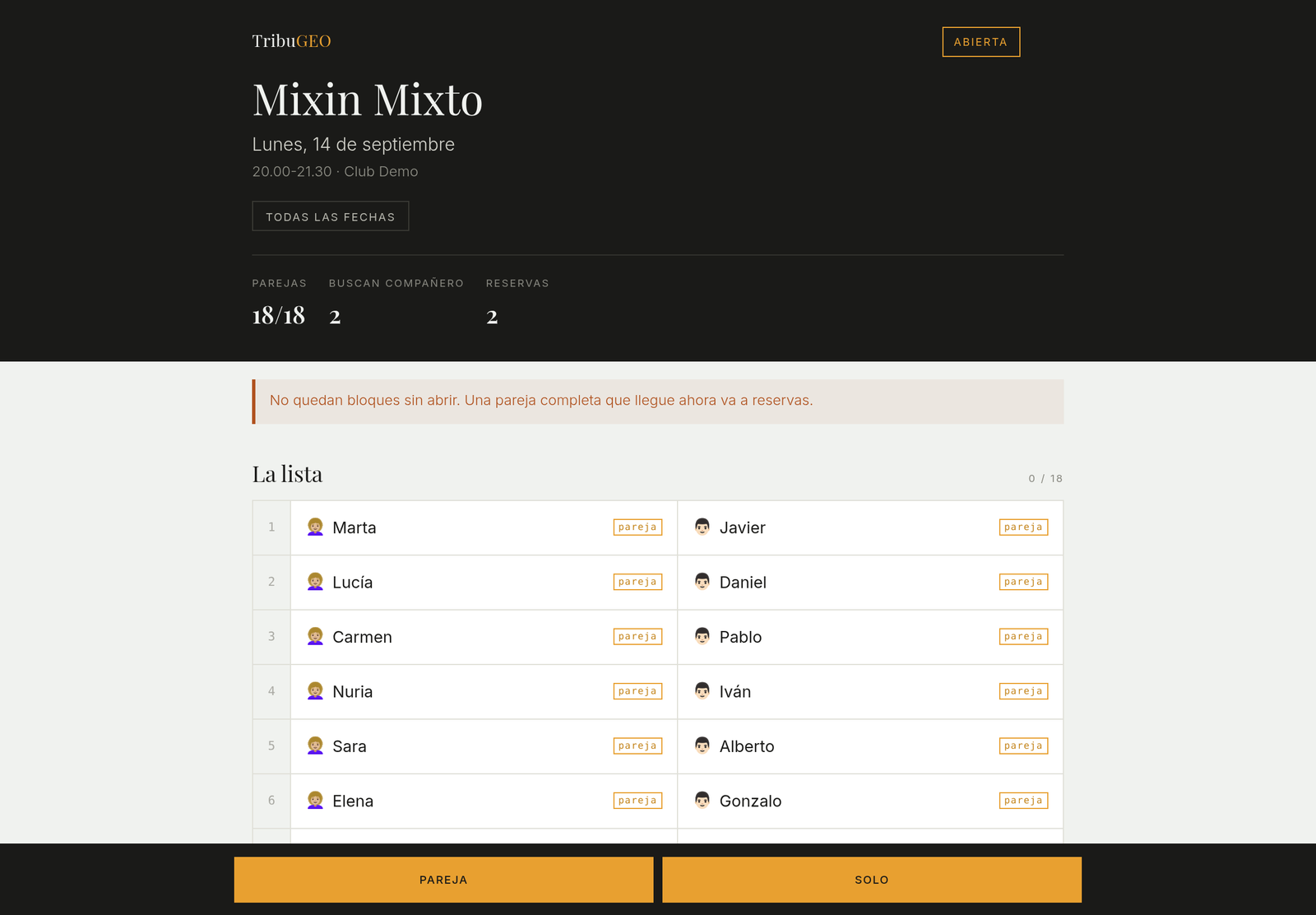
Publishes the event once. People sign up and pay by themselves, the waiting list moves up by itself, and the organiser pairs players, assigns courts and match-ups from their panel, and messages the group if they feel like it. If they need the full draw, they get it free from the generator.
Frequently asked questions about the padel americano
How many players do you need for a padel americano?
The real minimum is 5 players on one court (four play and one sits out each round). It gets comfortable from 8 with two courts, and the most common size at a club is 12 to 20 players across three to five courts.
How long does a padel mixin last?
Between 90 minutes and two and a half hours. With 15-minute rounds plus 3 to change over, six rounds is 108 minutes of play. Add 10 minutes of check-in at the start and 10 for prizes at the end.
How is a padel americano scored?
The standard is to add up the games each player wins across all their rounds; whoever accumulates the most games wins. Ties are broken by the head-to-head between the tied players or, if they have not met, by games conceded.
Is an americano the same as a pozo?
No. In an americano the draw is fixed before you start and every player partners everyone else. In a pozo you move up and down the courts depending on whether you win or lose, and pairs are remade each round from whoever is on that court.
Can you run an americano with an odd number of players?
Yes, with a rotating bye: each round one or more players sit out, and the draw is arranged so everyone sits out the same number of times. The draw generator works it out automatically for 5 to 24 players.
What is a mixed padel americano?
An americano in which every pair in every round is one man and one woman. It is played exactly like a standard americano, but you need to invite the same number of men and women so the pairing works in every round.
What is the difference between an americano and a Team Americano?
In an americano you change partner every round and the points are yours. In a Team Americano the pair stays fixed for the whole event, what rotates is the opponents, and points are added up per pair.
Is there a free app to build a padel americano draw?
Yes. The Mixines draw generator is free and needs no sign-up: it works out rounds, match-ups and courts for 5 to 24 players, ready to print or share on WhatsApp. If you also want sign-up, the waiting list and payment to run themselves, that is what Mixines does, and it has a free plan.
Everything on mixins and americanos
The pages that go deeper into each part of this guide.
Run your first mixin without opening a single spreadsheet
Publish the event, send the link and let the list and the payments handle themselves.